IFRS 18 Explained for the People Who Read Financial Statements
IFRS 18 applies from 1 January 2027. What changes for the reader of an income statement, what does not, and what it means for comparing companies.
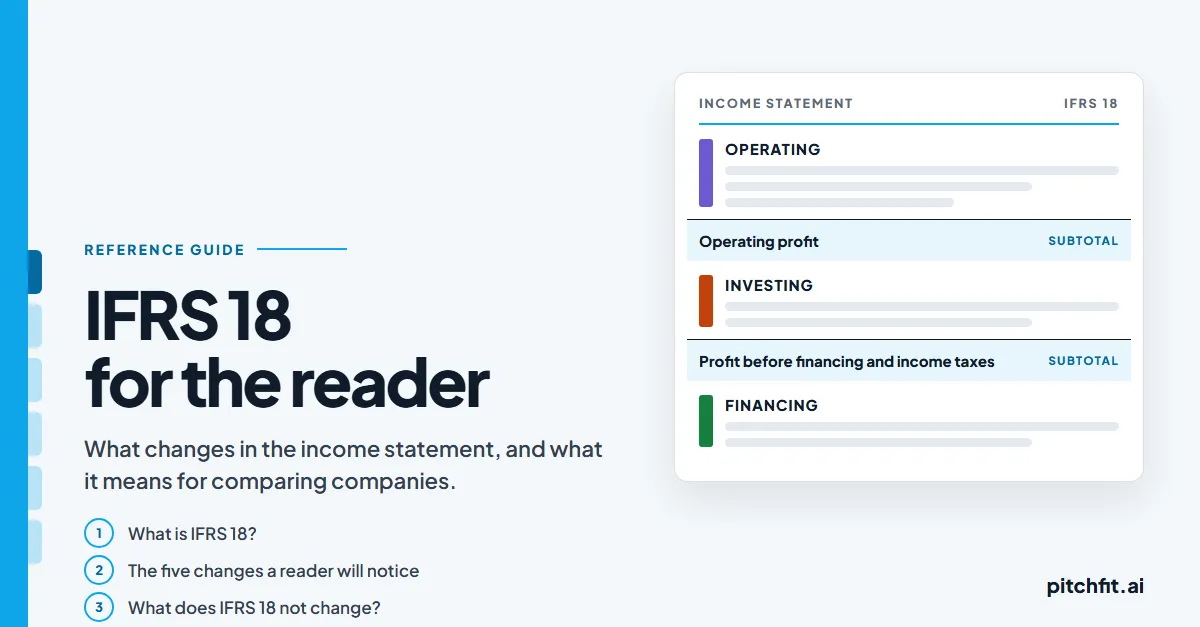
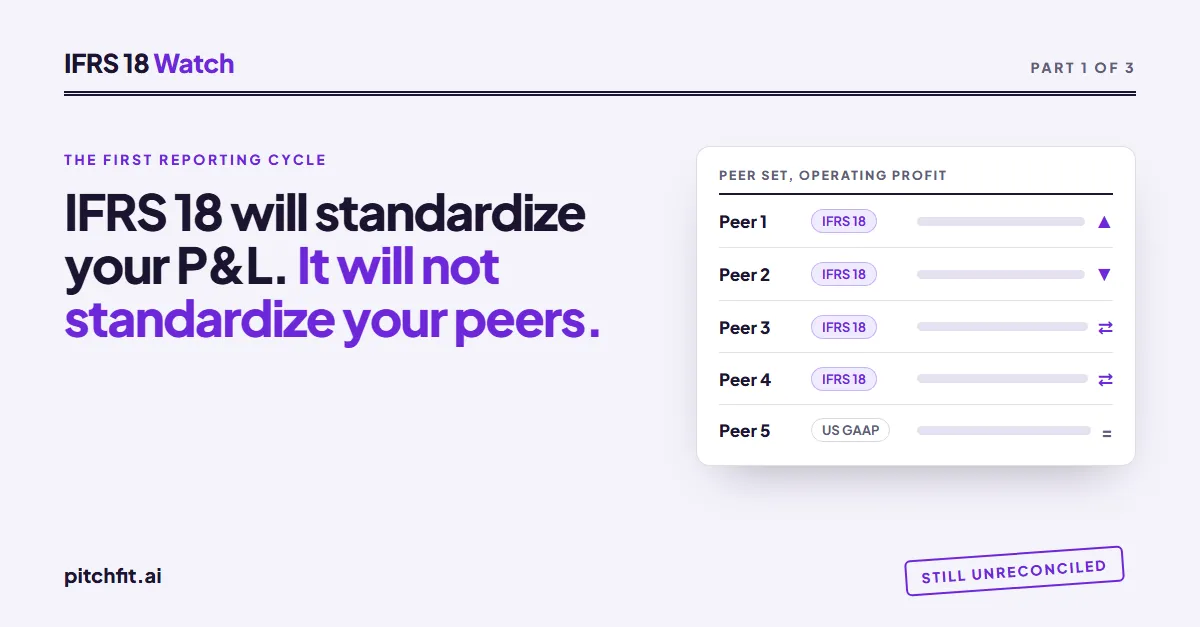
IFRS 18 will make every company's income statement easier to read from 2027. It will not make any two companies easier to compare. If you compare results for a living, that distinction is the whole story.
IFRS 18 replaces IAS 1 for annual periods beginning on or after 1 January 2027, with 2026 comparatives restated. Almost everything written about it is for preparers. This guide is for the reader: the board member, investor, lender or analyst who has to put one company's results next to another's.
Summary
- IFRS
- The accounting rules used by listed companies in the EU, the UK and many other countries.
- IAS 1
- Today's IFRS rule for how the financial statements are laid out. IFRS 18 replaces it.
- Income statement
- Revenue, costs and profit for the year.
- Subtotal
- A line that adds up the lines above it, such as operating profit.
- MPM
- Management-defined performance measure: a company's own adjusted figure, such as adjusted EBITDA.
- Comparatives restated
- The previous year's figures redone on the new rules, so the two years line up.
- US GAAP
- The US accounting rules. IFRS 18 does not change them.
What is IFRS 18?
Issued by the IASB in April 2024, IFRS 18 Presentation and Disclosure in Financial Statements replaces IAS 1. It changes where items sit and what must be explained; it does not change how anything is measured or recognized. Effective date: annual periods beginning on or after 1 January 2027, early adoption permitted, comparatives restated. A December year-end company's first IFRS 18 accounts, for 2027, will also show 2026 on the new basis.
The five changes a reader will notice
- Three categories in the income statement. Income and expenses are classified as operating, investing or financing; income taxes and discontinued operations are shown separately. Operating is the residual: everything that is not investing or financing.
- Two mandatory subtotals. Operating profit or loss, and profit or loss before financing and income taxes. Operating profit now has a definition under IFRS rather than a house convention.
- Management-defined performance measures (MPMs) in the audited notes. Any subtotal a company uses in public communications to convey its view of performance, adjusted EBITDA or underlying operating profit, must be disclosed in one note, reconciled to the nearest IFRS subtotal, with the reason it is useful and the tax and non-controlling-interest effect of every reconciling item.
- Aggregation and disaggregation rules. Items are grouped by shared characteristics; dissimilar items may not be combined; "other" is allowed only when no more descriptive label exists. Expect more lines, on the face and in the notes.
- Specified main business activities. Companies whose main business is investing in assets or providing financing to customers (banks, lessors, investment entities) classify the related income and expenses in operating, because that is their business.
| Section | What goes in it |
|---|---|
| Operating | Revenue and the costs of running the business |
| Operating profit or loss | Required subtotal |
| Investing | Income from investments, such as associates, for a company whose business is not investing |
| Profit or loss before financing and income taxes | Required subtotal |
| Financing | Interest on borrowings and similar costs |
| Income taxes and discontinued operations | Shown separately |
| Profit or loss for the year | What is left after all of the above |
What moves: Unilever, 2024
Unilever reports under IFRS with a December year-end, so its 2027 accounts will be among the first full sets under IFRS 18, with 2026 restated. Its 2024 income statement (EUR millions, Form 20-F) shows how the pieces re-sort.
| Category under IFRS 18 | Line item, 2024 | EUR m |
|---|---|---|
| Operating | Operating profit, as reported | 9,400 |
| Net monetary loss from hyperinflationary economiesa | (195) | |
| Operating profit under IFRS 18 (mandatory subtotal) | 9,205 | |
| Investing | Share of net profit of joint ventures and associates | 255 |
| Finance incomeb | 438 | |
| Other income from non-current investments and associates | 13 | |
| Profit before financing and income taxes (mandatory subtotal) | 9,911 | |
| Financing | Finance costs | (1,113) |
| Pensions and similar obligations (net interest) | 71 | |
| Profit before taxation Unchanged | 8,869 | |
- Operating: the standard classifies the IAS 29 net monetary gain or loss, when presented as a single line, in the operating category
- Investing, for a company whose main business is not financing
Two consequences.
- The operating subtotal itself moves: the hyperinflation loss that Unilever shows below operating profit today sits inside it under IFRS 18, so the first number on the restated 2026 income statement will be lower than the one previously published, for no operating reason.
- And Unilever's management measure moves into the audited notes: in 2024 underlying operating profit was 11,179 against reported operating profit of 9,400, a gap of 1,779 made up of restructuring (850), the loss on disposal of group companies (406, including a 545 write-off of currency translation reserves), acquisition and disposal costs (387), impairments (133) and other items.
Today that reconciliation lives in the segment note and starts from 9,400. Under IFRS 18 it starts from 9,205 and becomes an MPM disclosure: each item with its tax effect, a stated reason the measure is useful, and the standard's own warning that it may not be comparable with other companies' measures. A reader comparing Unilever with a peer that treats restructuring as a recurring cost sees the difference in print for the first time.
What it does for the reader
- Operating profit becomes comparable over time once the restatement is through.
- Adjusted figures that lived in the investor presentation must show their workings in the audited accounts.
- The "other" bucket shrinks, so the cost base is easier to read.
What does IFRS 18 not change?
- Nature or function stays a choice. Two peers can present operating expenses in incompatible ways and both comply.
- Judgments inside operating stay company-specific. Whether a restructuring charge or a lease adjustment is "operating in character" is still decided one company at a time.
- Fiscal year-ends are untouched. A March year-end next to a December one is still a different twelve months.
- US GAAP is untouched. A peer set with American companies in it has half its members on a different rulebook.
- MPMs are reconciled, not harmonized. The note shows how one company gets from IFRS to its adjusted number, not how that number relates to a peer's.
The transition year, for anyone building a comparison
In the first cycle each company restates its comparatives on its own judgment of where legacy items land. Five IFRS peers will produce five restatements, each defensible, each different, and any US GAAP peers will not move at all. Three rules for that year:
- Read each transition note before the numbers.
- Rebuild operating profit on one stated basis for the whole peer set; do not take each company's new subtotal as comparable.
- Keep the MPM notes side by side, because that is where the judgments are written down.
Does IFRS 18 make companies comparable?
IFRS 18 is the first IFRS standard to define the categories a comparison needs, operating, investing and financing, and the first to force adjusted measures into audited, reconciled disclosure. That makes it the natural target basis for comparing companies across rulebooks. It is how PitchFit works: every statement, IFRS or US GAAP, is mapped to one IFRS-first template with IFRS 18 as the comparison profile, every reclassification carried as an explicit, versioned bridge, and every figure traced to the printed source.
Frequently asked questions
When does IFRS 18 take effect?
Does IFRS 18 change how profit is measured?
What is a management-defined performance measure?
Does IFRS 18 affect US GAAP companies?
Does IFRS 18 define operating profit?
Notes from the team building PitchFit.
 IFRS 18 Watch
 Financial ratios
 Insights
 Restructuring
 SurveyIFRS 18 WatchFinancial ratiosInsightsRestructuringSurvey
