Financial Leverage Ratio: Four Formulas, One Company, Four Answers
The financial leverage ratio, four ways: debt to equity, debt to capital, the equity multiplier and net debt to EBITDA, from Apple's FY2024 10-K.
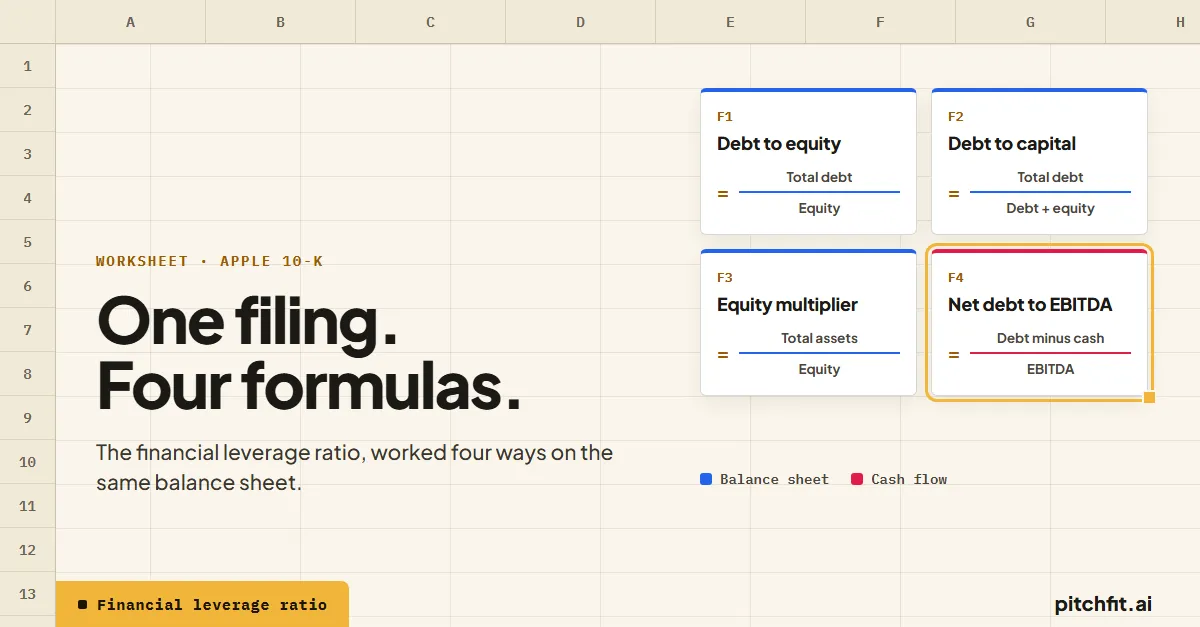
"Financial leverage ratio" is not one ratio. It is at least four, they measure different things, and Apple's FY2024 accounts show a company that is heavily leveraged on one of them and has no net debt at all on another. Before you compare any leverage figure across companies, ask which formula it is and how debt, cash and EBITDA were defined.
Summary
- Financial leverage ratio
- Any ratio that shows how much of a company is funded by borrowing. This article computes four.
- Debt
- Money borrowed that has to be paid back. Here: term debt and commercial paper.
- Commercial paper
- Short-term borrowing, usually repaid within months.
- Shareholders' equity
- What belongs to the owners: everything the company owns minus everything it owes. Buybacks reduce it.
- Total assets
- Everything the company owns, from cash to factories.
- EBITDA
- Operating income with depreciation and amortization added back: a rough measure of a year's cash from operations.
- Net debt
- Debt minus cash. Below zero, the company holds more cash than it owes.
- Buyback
- A company using its cash to buy its own shares back from investors.
- Marketable securities
- Investments, such as bonds, that can be sold quickly for cash.
What is the financial leverage ratio formula?
Apple's inputs, FY2024
| Line item (as filed) | USD millions |
|---|---|
| Term debt, current | 10,912 |
| Term debt, non-current | 85,750 |
| Commercial paper | 9,967 |
| Total debt | 106,629 |
| Cash and cash equivalents | 29,943 |
| Marketable securities, current | 35,228 |
| Marketable securities, non-current | 91,479 |
| Total shareholders' equity | 56,950 |
| Total assets | 364,980 |
| Operating income | 123,216 |
| Depreciation and amortization | 11,445 |
| EBITDA (operating income plus D&A) | 134,661 |
The four answers
| Ratio | Calculation | Result | Reads as |
|---|---|---|---|
| Debt to equity | 106,629 / 56,950 | 1.87x | Heavily leveraged for a technology company |
| Debt to capital | 106,629 / (106,629 + 56,950) | 0.65 | Two thirds of capital is debt |
| Equity multiplier | 364,980 / 56,950 | 6.41x | Assets are more than six times equity |
| Net debt to EBITDA, cash only | (106,629 minus 29,943) / 134,661 | 0.57x | Barely leveraged |
| Net debt to EBITDA, cash plus all marketable securities | (106,629 minus 156,650) / 134,661 | negative 0.37x | Net cash; no leverage at all |
Same company, same filing, same day. The balance-sheet ratios describe a company funded two thirds by debt with assets six times its equity. The cash-flow ratio describes a company that could repay every dollar it owes from seven months of EBITDA, or that has no net debt at all once its securities portfolio is counted.
Why do Apple's leverage ratios disagree?
The balance-sheet ratios are high because Apple's equity is small, and equity is small because of share repurchases. From the cash flow statement: repurchases of common stock were 89,402 in FY2022, 77,550 in FY2023 and 94,949 in FY2024. Total shareholders' equity went from 63,090 at the start of FY2022 to 56,950 at the end of FY2024, while the company generated 118,254 of operating cash flow in FY2024 alone. Retained earnings are being returned to shareholders faster than they accumulate, so the equity denominator shrinks while assets and debt do not.
Debt to equity and the equity multiplier therefore measure Apple's capital allocation policy, not its financial risk. Net debt to EBITDA measures the risk, and it is close to zero.
A reader who compares Apple's 1.87x debt to equity with a peer that does not buy back shares is comparing policy, not solvency.
The three definitional choices, on Apple's numbers
What counts as debt. Term debt plus commercial paper gives 106,629. Exclude commercial paper, as some analysts do for a company with this much liquidity, and debt is 96,662, debt to equity 1.70x. Apple's lease liabilities (operating and finance leases, disclosed in the leases note) would add to debt under a rating agency's definition and move the ratios up again.
What counts as cash. Cash and equivalents alone are 29,943. Add current marketable securities and the figure is 65,171. Add non-current marketable securities and it is 156,650. Net debt to EBITDA moves from 0.57x to 0.31x to negative 0.37x on that choice alone. Three defensible answers to "is Apple net cash?" and only one of them says no.
What counts as EBITDA. Operating income plus D&A as filed gives 134,661. Apple reports no adjusted EBITDA, so there is no management measure to reconcile; for most companies there would be, and the adjusted figure would be higher.
Which leverage ratio should an analyst use?
Debt to equity remains the most searched and the most quoted. On Apple it is also the least informative, because the denominator is a policy choice.
Why this matters for comparison
Across companies, all four ratios are comparable only when debt, cash and EBITDA are defined the same way for every company in the set, and filings do not do that for you. One company prints commercial paper inside short-term borrowings, another beside it; one holds its liquidity in cash, another in a securities portfolio two lines down; one reports adjusted EBITDA, another nothing. That is why PitchFit maps every statement to one canonical template before any ratio is computed: debt, cash and operating profit sit on the same lines for every company, every reclassification is an explicit bridge, and every ratio can be traced to the printed figure it came from.
Frequently asked questions
- What is a good financial leverage ratio?It depends on which ratio. Net debt to EBITDA below 2x is generally considered conservative for an industrial company and below 3x acceptable; debt to equity and the equity multiplier have no universal benchmark because they depend on buyback policy and asset intensity.
- Is the financial leverage ratio the same as debt to equity?No. Debt to equity is one of several leverage ratios; the equity multiplier (total assets / equity) is the formula most textbooks mean by "financial leverage ratio", and net debt to EBITDA is what lenders mean.
- Why does Apple have a high debt to equity ratio?Because share repurchases have reduced its equity to 56,950 against 106,629 of debt. Its net debt is close to zero once marketable securities are counted.
- Should marketable securities count as cash in net debt?Only if they are liquid and unrestricted, and the choice must be stated and applied the same way to every company being compared. On Apple it moves net debt to EBITDA from 0.57x to negative 0.37x.
- Does the equity multiplier include debt?Indirectly: total assets equal liabilities plus equity, so a higher multiplier means more of the assets are funded by liabilities of any kind, not just interest-bearing debt.
Notes from the team building PitchFit.
 IFRS 18
 IFRS 18 Watch
 Insights
 Restructuring
 SurveyIFRS 18IFRS 18 WatchInsightsRestructuringSurvey
