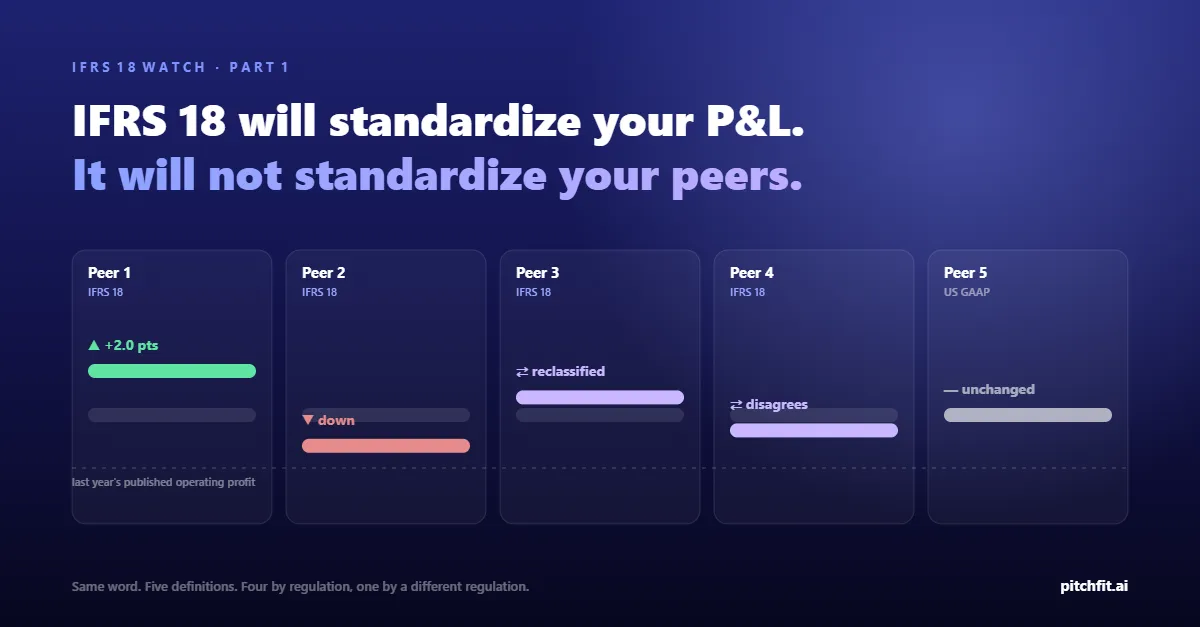
IFRS 18 will standardize your P&L.It will not standardize your peers.
The standard fixes the structure of one company's income statement. It does not fix the comparison between two.
The standard fixes the structure of one company's income statement. It does not fix the comparison between two. The first reporting cycle will put every peer set through a restatement that each company handles its own way, while US GAAP peers carry on unchanged. Finance teams that benchmark against peers need a basis underneath the reported numbers before that cycle begins, not after.
The first board pack under IFRS 18
Consider the head of strategy at a listed industrial, preparing the annual competitor benchmark the board has received in the same format for nine years. Five peers. Operating margin, SG&A intensity, return on capital. The pack is due in three weeks.
This year, four of the five peers have published their first IFRS 18 accounts. Operating profit now has a definition. Comparatives have been restated. The fifth peer reports under US GAAP and has not changed anything.
She opens the first restated report. Operating profit is up two points against last year's published figure, not because the business improved but because a disposal gain and the share of an associate's profit have moved below the operating line. The second peer's operating profit is down, because a foreign exchange loss that used to sit in financing now sits in operating. The third has reclassified its lease interest. The fourth disagrees with the third on where the same item belongs, and says so in its transition note.
The US peer is untouched. Last year's comparison between it and the four IFRS companies was already imperfect. This year it is not a comparison at all.
She has three weeks and five companies that each define operating profit differently, four of them by regulation and one by a different regulation.
What the standard does, and where it stops
Within one company, IFRS 18 is real progress. Income and expenses fall into operating, investing and financing categories. Operating profit and profit before financing and income taxes become mandatory subtotals. Any "adjusted EBITDA" or "underlying profit" must be disclosed in a single audited note, reconciled to the nearest IFRS line, with the tax effect of every adjustment shown. The number that used to live in the investor deck now has to show its workings.
Across companies, the standard stops at four places, and every one of them lands on the head of strategy's desk.
Operating expenses can be shown by nature, by function, or a mix. Two peers can pick opposite methods and both comply. The cost line she wants to compare still sits in a different place with a different label.
Whether a restructuring charge or a lease adjustment is operating in character is still decided company by company. The categories narrow the field. They do not remove the discretion.
For a bank it is operating, because lending is the business. For everyone else it is investing or financing. A conglomerate with a captive finance arm or a retailer with a store card lands in between. Same words, different places, both correct.
Nothing in IFRS 18 aligns a March year-end to a December one, and nothing in it touches an American filer.
Operating profit is now defined. It is still not the same measure from one peer to the next.
The adjusted number becomes visible, not comparable
The change finance teams will notice first is the management measures note. Each company now shows how it gets from the IFRS subtotal to its preferred adjusted figure. That improves transparency. It does nothing for comparability. The note tells her how Peer A defines underlying EBITDA. It does not make Peer A's definition the same as Peer B's. It puts the two definitions in audited print, side by side, and leaves the reconciliation between them to her.
For the first time, the differences in how peers define the same word will be printed, audited, and still unreconciled.
The reported statement is the input, not the basis
During the transition, the person who reconciles the analysts' judgments must also reconcile the companies', one restatement note at a time, for every company in the set, in the same cycle. That is the work a spreadsheet was never built to carry.
A defensible benchmark needs a layer underneath the published numbers: the same economic item on the same canonical line for every company regardless of label, one-offs lifted into their own layer rather than left in operating cost, every fiscal year rebuilt from the quarterlies onto one twelve-month window, and every figure bridged back to the line in the filing it came from.
IFRS 18 makes the input cleaner. It does not build that layer. It does make the absence of one impossible to hide.
That layer is what PitchFit is: a universal canonical statement, already built on IFRS 18's mandatory subtotals, that takes filings as published and makes them comparable across companies, including a private company's own accounts next to its listed peers. Every statement, standardized one way. Every figure traced to source. So no one has to choose which version of the numbers to believe.
Illustrative scenario; no specific company or engagement is described. PitchFit standardizes every filing onto one defensible, IFRS 18-ready basis. Join the waitlist at pitchfit.ai.