What Happens to "Adjusted" Profit When It Has to Go Through the Audit?
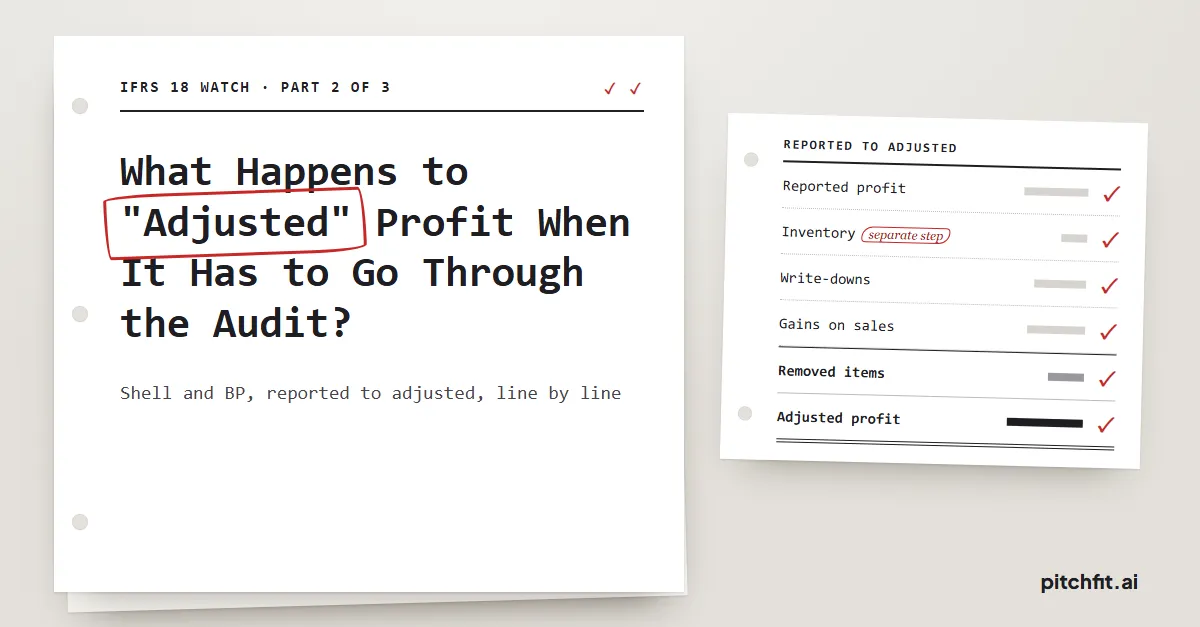
IFRS 18 moves the bridge from reported to adjusted profit into the audited notes from 2027. Shell's and BP's 2025 bridges show what that fixes.
IFRS 18 Watch, Part 2
Most large companies report two profit numbers: the one the accounting rules produce, and an "adjusted" one that strips out items management considers one-off. In 2025 Shell's two numbers were almost the same. BP's adjusted profit was 136 times its reported profit. From 2027, IFRS 18 requires the bridge between the two numbers to sit inside the audited accounts, item by item. That makes the bridge easier to check. It does not make one company's "adjusted" mean the same as another's.
Summary
Key point: the audit will confirm that each company's bridge adds up. It will not decide what belongs in the bridge; each company still decides that for itself.
What changes from 2027: every item a company removes is listed in the audited notes with its tax effect; the note must say the measure is management's view and may not be comparable; and if a company changes its definition, it must say so and restate last year. What does not change: which items a company chooses to remove, and the fact that two companies in the same industry can choose differently.
Terms in this article
- Reported profit
- the profit the accounting standards produce.
- Adjusted (or "underlying") profit
- reported profit with certain items removed because management treats them as outside normal performance. Shell calls the removed items identified items; BP calls them adjusting items.
- Gross vs net
- the gross value of the items is the total of everything removed, in both directions; the net is what is left after the positives and negatives cancel.
- CCS / replacement cost adjustment
- an oil-industry convention that removes the effect of oil-price swings on inventory. It is a separate step, not one of the removed items.
- Management-defined performance measure (MPM)
- IFRS 18's name for any adjusted profit figure a company uses in public.
What did Shell remove in 2025?
Key point: Shell removed items worth 8.2 billion dollars in total, but they almost cancelled out: the net effect was 53 million on a profit of 17.8 billion.
The reason is simple: Shell booked 3.3 billion of gains from selling assets and 3.0 billion of write-downs in the same year. Both were removed, and they offset each other.
| USD m | |
|---|---|
| Reported profit attributable to shareholders | 17,838 |
| Inventory (CCS) adjustmenta separate step | 638 |
| Profit after the CCS adjustment | 18,476 |
| Write-downs of assets (impairments) | 2,955 |
| Restructuring and redundancy costs | 293 |
| Fair value movements on derivatives and gas contracts | (714) |
| Gains on selling assets | (3,303) |
| Currency and inflation effects on tax balances | (51) |
| Other items | 873 |
| Net effect of all identified items | 53 |
| Adjusted Earnings | 18,529 |
What this shows: a reader who looks only at the net (53) sees reported and adjusted profit agreeing. A reader who looks at the gross (8.2 billion) sees the two biggest events of the year, the asset sales and the write-downs, sitting inside the adjustment. Both readings are correct; they answer different questions.
What did BP remove in 2025?
Key point: BP's reported profit was 55 million. After removing its adjusting items, its underlying profit was 7.5 billion. Every item is disclosed, and the underlying figure is the one BP's dividend and guidance are based on.
| USD m | |
|---|---|
| Reported profit attributable to shareholders | 55 |
| Inventory (replacement cost) adjustment, after taxa separate step | 1,017 |
| Profit after the inventory adjustment | 1,072 |
| Write-downs and losses on selling businesses and assets | 5,048 |
| Fair value movements, including a 1,157 gain on hybrid bonds | (2,220) |
| Restructuring and integration costs | 520 |
| Environmental and other provisions | 656 |
| Finance costs treated as adjusting | 428 |
| Gulf of America oil spill | 31 |
| Other, including 1,082 of write-downs in joint ventures | 1,422 |
| Adjusting items before tax | 5,885 |
| Tax on adjusting items (net of a 774 tax-rate change) | 528 |
| Adjusting items after tax | 6,413 |
| Underlying replacement cost profit | 7,485 |
What this shows: the gap between 55 million and 7.5 billion is not hidden: every line is on the page. But it is BP's list, built on BP's definitions.
Why do the two lists differ?
Key point: Shell and BP are in the same industry and reported the same year, yet they treated six kinds of item differently. Each choice is disclosed and each is allowed under the rules.
| Shell | Kind of item | BP |
|---|---|---|
| Removed (293 after tax; 712 in 2024) | Restructuring costs | Removed (520 before tax; 222 in 2024) |
| Removes currency and inflation effects on tax balances | Tax effects | Removes a 774 tax-rate change |
| Kept in, apart from 4 | Finance costs | 428 removed |
| No such item | Hybrid bond fair value | 1,157 gain removed |
| Shown with the other write-downs | Write-downs inside joint ventures | Shown within "Other" (1,082) |
| Shown on their own line (3,303 removed) | Gains on selling assets | Combined with write-downs in one line |
For comparison, ExxonMobil (which reports under US accounting rules, where IFRS 18 does not apply) removed 419 of restructuring and 1,855 of write-downs from its own 2025 adjusted earnings. Its list can still be read on the same basis as Shell's and BP's, as Section 6 explains.
What does moving the bridge into the audited notes change?
Key point: three new requirements: a tax effect per item, a comparability warning, and a rule on changing definitions. It does not add a common definition.
- Tax effect per item. Today both companies show tax on the total only (Shell 203, BP 528 in their 2025 results). From 2027 each item carries its own tax effect, so a reader can see what each removal is worth after tax.
- A comparability warning. The note must state that the measure reflects management's view and may not be comparable with other companies' measures.
- A rule on changes. If a company changes what it removes, it must explain the change and restate the prior year on the new basis. The CCS and replacement-cost adjustments count as management-defined measures too, and carry the same disclosures.
What the note does not do is tell companies what to remove. A company that has removed restructuring costs for two years running may keep doing so, as long as it explains. And measures based on cash flow or the balance sheet (net debt, free cash flow, gearing) are outside these rules entirely.
For a finance team the practical point is timing: definitions settled before the first IFRS 18 accounts go in as the starting basis; definitions changed afterwards are visible as changes, with last year restated.
How do you compare two companies' adjusted profit fairly?
Key point: start both from the same IFRS 18 operating profit, remove the same kinds of item from both, and extend the same treatment to US companies. The result matches neither company's own figure, and that is the point.
In three steps:
- Start from the same line. Use the IFRS 18 operating profit that Part 3 derives for all four companies (Shell and BP from their statements, ExxonMobil and Chevron from theirs), not any company's own adjusted figure.
- List every removed item from both companies in one table, with the tax effect the new note will provide.
- Decide once, for everyone, what comes out. For example: write-downs and gains on asset sales are either both removed or both kept; restructuring is removed only where a company's own history shows it is not recurring; tax-rate changes stay in. The same decisions are applied to ExxonMobil and Chevron using their own published reconciliations.
The result is one adjusted profit, defined once, with every step traceable to an audited disclosure. It will equal neither Shell's 18,529 nor BP's 7,485. It is built to be comparable, not to reproduce either company's number.
Part 3 derives the starting line. Shell's income statement does not currently show an operating profit at all; on our reading of the standard and Shell's 2025 disclosures, the first one it presents under IFRS 18 would be around 3 billion dollars lower than the EBIT figure most data providers show for it today.
Frequently asked questions
Does IFRS 18 ban adjusted profit or adjusted EBITDA?
No. It requires any such figure used in public to be disclosed in one audited note, reconciled to the nearest IFRS subtotal, with the tax effect of each item.
Does the audited note make adjusted profit comparable between companies?
No. Each company still chooses its own items. The note shows how one company gets from its reported figure to its own adjusted figure, and must say the result may not be comparable.
Can a company change its definition of adjusted profit after 2027?
Yes, but it must explain the change and restate the prior year, so the change is visible.
Are net debt, free cash flow and gearing covered?
No. The rules apply to profit subtotals only. Cash-flow and balance-sheet measures are outside them.
Why do the rules not apply to ExxonMobil or Chevron?
IFRS 18 applies to companies reporting under IFRS. US companies follow US GAAP and SEC rules on non-GAAP measures, outside the audited accounts. Their adjusted figures can still be read on the same basis as an IFRS company's, using their own published reconciliations.
Sources: Shell plc, fourth quarter and full year 2025 unaudited results, identified items and Adjusted Earnings reconciliation; bp p.l.c., fourth quarter and full year 2025 results, adjusting items by category and reconciliation to underlying replacement cost profit; ExxonMobil, 2025 results, earnings excluding identified items. IFRS 18 requirements are described from the published standard. Neither company has yet published an IFRS 18 transition note; the classifications discussed here are the authors' reading of the standard and may differ from the companies' eventual presentation.
 Restructuring
 IFRS 18 Watch
 IFRS 18
 IFRS 18 Watch
 Financial ratiosRestructuringIFRS 18 WatchIFRS 18IFRS 18 WatchFinancial ratios