Back to blogThe Pain-point: What Market Research Tells Us
SurveyThe PitchFit Premise5 min readJun 9, 2026

The Pain-point: What Market Research Tells Us

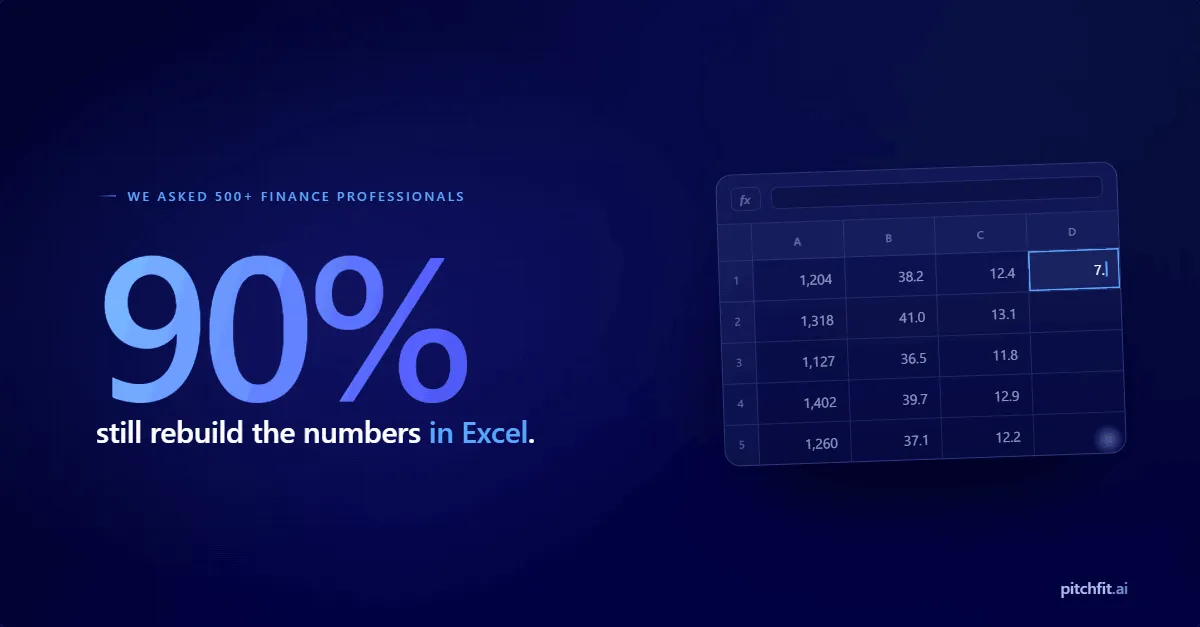
We Asked 500+ Finance Professionals About Their Data. 90% Are Still Re-Keying Numbers Into Excel.

There is a number in our recent survey that I keep coming back to, because it should not be possible. We surveyed more than 500 professionals about how they work with cross-company financial data: analysts, FP&A teams, consultants, founders, investors, auditors. These are people with access to the best tools the industry sells, from Bloomberg terminals to CapIQ, FactSet, Pitchbook and AlphaSense.

Among those who work with filings, comparisons and valuations as part of their role, 90% told us they still rely on Excel and manual extraction to do the actual work. Not as a backup. As the workflow. Pulling numbers out of expensive platforms, or straight out of 200-page filings, and re-keying them into spreadsheets line by line, so they can finally read company financial data. Most spend four to ten hours a week on it. A quarter spend more than ten. At fully loaded analyst cost, that is a five-figure annual tax per analyst just to make the data usable, before a single insight has been produced.

If you run a finance, strategy or investment team, that is worth sitting with for a moment. You are paying twice: once for the data, and once again, in your team's hours, to fix it.

Why the spreadsheet won't die The lazy explanation is habit. Finance people love Excel; old workflows die hard. I do not buy it, and the survey data does not support it either. When we asked what actually makes cross-company comparison hard, the answers were not about tooling preferences. They were about trust and basis.

The single most cited challenge, named by 1 in 2 respondents and rising to 57% among people who do this work weekly, was that the same line item is classified differently from one company to the next. One company's cost of revenue is another's operating expense. One capitalizes what another expenses. The provider data faithfully reflects each company's own presentation, which means it faithfully reproduces the inconsistency.

Close behind came a cluster of issues that are really one issue wearing different clothes: reconciling third-party data back to source filings, doubts about third-party accuracy, and the lack of an audit trail from a number back to where it came from. Put those together and nearly 3 in 4 respondents flagged at least one trust problem with the data underneath their own analysis. One in two named calendarisation, the work of aligning mismatched fiscal years, as a barrier before comparison can even begin. About a quarter pointed to industry-specific accounting nuances like leases, derivatives and pensions.

Read those findings as a list and a pattern emerges. People do not rebuild statements in Excel because they like Excel. They rebuild them because the only basis they fully trust is the one they constructed themselves, where they made the classification calls, they aligned the fiscal years, and they can defend every cell if challenged in a meeting.

The spreadsheet is not the workflow. It is the coping mechanism.

The cost nobody books Here is what makes this expensive in ways that never show up on a budget line. When every analyst builds their own trusted basis, every analyst builds a different trusted basis. The judgment calls, what counts as recurring, what counts as operating, where the lease adjustment goes, get made independently, invisibly, and inconsistently. Same company, same question, different answers. Anyone who has watched a leadership meeting dissolve into an argument about whose measurement is right knows exactly what that costs: not just the hours, but the decision that did not get made that day.

And the quiet finding underneath all of this is the most uncomfortable one. The people producing these numbers are telling us, in large numbers, that they do not fully trust the manual reconciliations involved. The analysis that reaches the board is built on work its own authors hold at arm's length.

What respondents said they actually want We also asked what would help. The answers were strikingly consistent. 93% said a side-by-side peer comparison, defined the same way every time, would be valuable, including 37% who described their current manual process as outright painful. 91% saw value in asking plain-language questions across filings, transcripts and news and getting a sourced answer. And 85% valued being able to pull standardized metrics straight into a presentation, because the deck is where most of this work ends up anyway.

None of that is a request for more data. Everyone in this survey is drowning in data. It is a request for data that arrives already on one basis, already aligned, already traceable to source, so the analyst's hours go into the thinking, not the re-keying.

That is the gap PitchFit was built to close: every statement, standardized one way, with every figure tracing back to its filing. The 90% number at the top of this piece is our benchmark. The product works when it falls.

Survey conducted among 500+ professionals. PitchFit opens early access soon. Join at pitchfit.ai, and if you would like the full aggregate results, ask us.